Copyrights, are common concerns for craftspeople. If you've invented a unique product, you will more than likely want to protect it from others who can create knock-offs of your craft show gem at cheaper prices. Although it may be flattering to have created a craft item others want to duplicate, it can also be a nightmare to see your distinctive creation on the Home Shopping Network! The United States Patent and Trademark
Organization Web site (
http://www.uspto.gov/) is a good place to learn the differences between trademarks and patents and to learn what is best for your situation. For more information and to apply for a copyright go to
http://www.copyright.gov/.
Although attorneys may be costly, some offer free 30-minute consultations, so you may be able to find one who can tell you what's the best protection for your craft show product. If you find the costs are prohibitive for you to secure a trademark, patent or whatever you find you need, you'll just have to take your chances without one. Again, check with other crafters through shows and forums, as well as your craft organizations to find out what they've done to protect their crafts. Those who have come before you can ease your way so you don't have to reinvent the wheel.
Your Copyright
"A copyright is a form of protection provided to the authors of 'original works of authorship' including literary, dramatic, musical, artistic, and certain other intellectual works, both published and unpublished. The 1976 Copyright Act generally gives the owner of copyright the exclusive right to reproduce the copyrighted work, to prepare derivative works, to distribute copies or phonorecords of the copyrighted work, to perform the copyrighted work publicly, or to display the copyrighted work publicly. This includes your craft show products.
The copyright protects the form of expression rather than the subject matter of the writing. For example, a description of a machine could be copyrighted, but this would only prevent others from copying the description; it would not prevent others from writing a description of their own or from making and using the machine. Copyrights are registered by the Copyright Office of the Library of Congress." (
http://www.copyright.gov/)
Most people think of copyrights for books or music and not creative arts like paintings or crafts, but a copyright can protect all forms of creative expression and visual arts. Visual arts are defined as original pictorial, graphic and sculptural works, which include two-dimensional and three-dimensional works
of fine, graphic and applied art. Some examples are:
Artificial flowers and plants Artwork applied to clothing or to other useful articles Collages Dolls, toys
Drawings, paintings,murals Enamel works Greeting cards, postcards, stationery
Jewelry designs Mosaics Needlework and craft kits
Original prints, such as engravings, etchings, serigraphs, silk screen prints, woodblock prints
Patterns for sewing, knitting, crochet, needlework
Reproductions, such as lithographs, collotypes
Sculpture, such as carvings, ceramics, figurines, molds, relief sculptures
Stained glass designs
Stencils, cut-outs
Weaving designs, lace designs, tapestries
A copyright gives the creator of the product exclusive rights to produce, sell and distribute the item. When your work is created, it is automatically copyrighted, however, for optimum protection, it's best to apply for a copyright. When obtained, you can add the copyright symbol (c) on all your materials.
Copyright your designs, so you have legal proof in case someone copies your work. A copyright does not automatically keep someone from stealing your designs—you'd have to find the culprit and enforce your rights, which may not be a simple matter and will require an attorney. Having the copyright, however, may deter someone from copying you, so at least that's a good place to start—and it only costs $30 per copyright!
About the Author
Natalie Goyette shows you how to make your craft show business profitable in her best selling ebook: Craft Show Success Secrets. Visit her site:
http://www.craftshowsuccess.com/
Source:
ArticleTrader.com
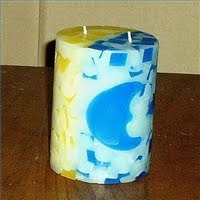 I recently got back into making candles. And my search for new ideas I found these instructions on how to make a chunk candle by SDKP, eHow Member. I always thought chunk candles as just chunks, not shapes. The author really did well incorporating the moon shape and dividing the candle down the middle with the two different colors. It really makes a statement. I am going to try this technique really soon. And over the years I have purchased a variety of cookie cutters to make soap embedds, now I have another use for them.

